WhatsApp may keep people talking, but does it give managers operational visibility?
Almost every growing business eventually creates a WhatsApp group for its team. It is familiar, quick to set up and already part of how people communicate every day.
For quick conversations, that works.
The challenge begins when those conversations become the main place for managing work.
Research on women-led businesses across Kenya and Nigeria found that WhatsApp has become an important part of day-to-day business activity, supporting tasks such as order coordination, supplier communication and customer follow-up. Its widespread use helps explain why businesses also turn to it for internal coordination.
But as a team grows, a messaging app can struggle to provide something managers need just as much as communication: visibility.
Important Information Can Disappear into the Conversation
A busy group chat does not distinguish between a task update, a schedule change and an unrelated message.
Everything enters the same stream.
An instruction shared in the morning can be buried under dozens of replies by the afternoon. When a manager needs to check what was agreed, they may have to search through the conversation, scroll back through messages or ask someone to send the information again.
The team is communicating. But the information is becoming harder to manage.
Decisions Need More Than a Message
Consider a simple situation.
A manager gives an instruction in a group chat. Someone acknowledges it. A few days later, there is a disagreement about what was actually agreed.
Which message was the final instruction? Who confirmed it? When was the decision made?
When important decisions exist only inside a conversation, finding a reliable record becomes difficult. The information is dependent on the chat remaining accessible and the right people remembering where it was posted.
That may not matter for casual communication. It matters considerably more when the conversation is carrying operational decisions.
More Groups Can Mean Less Visibility
Growth often creates another problem.
One team chat becomes several: a general group, a department group, a shift group and direct messages between individuals. Before long, information about the same operation is spread across multiple conversations.
A manager may know that communication is happening everywhere yet still struggle to see the full picture.
The issue is not necessarily a lack of communication. It is the lack of one clear place to understand what is happening.
Communication Should Support the Way Work Is Managed
Fast messaging still has its place. Teams need informal conversations, quick questions and immediate exchanges.
The problem comes when the same channel is expected to carry important operational information that needs to remain organized, searchable and accessible later.
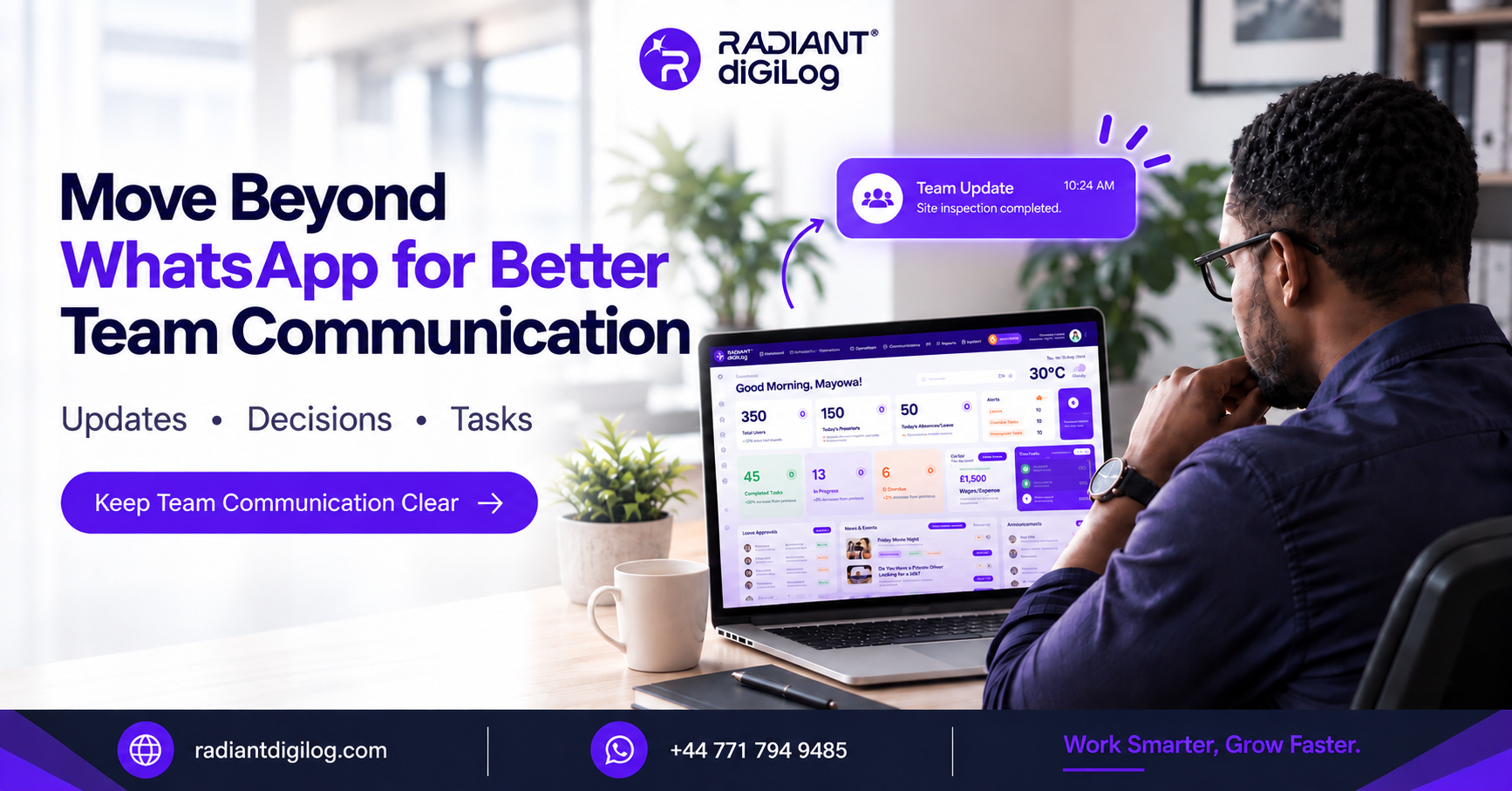
A centralized communication environment gives teams a way to keep important discussions connected to their day-to-day operations. With Radiant diGiLog, operational conversations can be organized by team and topic, making it easier for managers to find previous decisions and follow what is happening without relying on memory or scrolling through old messages.
The goal is not simply to give teams another place to chat.
It is to make communication useful long after the message has been sent.
Make your team’s operational communication easier to follow and find.