A completed status tells you something. Evidence tells you much more.
Construction managers make decisions based on information coming from the site every day. A supervisor reports that a task is complete, a project manager updates the schedule, and work moves forward. The problem begins when that update does not tell the whole story.
A task may be reported as finished while a defect remains unnoticed, an inspection is incomplete, or the required evidence is missing. On a busy project, these small gaps can accumulate quickly.
This challenge is particularly relevant in Nigeria, where delays remain a significant concern across the construction industry. A review published in Buildings reports that previous research found approximately 70% of construction projects in Nigeria experience delays during execution. The review also identifies factors including inadequate coordination and ineffective communication as contributors to project delays.
A Status Update Is Not the Same as Verification
Picture a project manager overseeing several active sites.
A message arrives: “The work is done.”
What does that actually confirm?
Was the task completed to the required standard? Was an inspection carried out? Were there any issues? Was the work completed on the expected date?
When completion depends mainly on a call or message, managers are often working with someone’s summary rather than a record they can check themselves.
That distinction becomes important when something needs to be revisited.
By the Time a Problem Reaches the Office, It May Be Too Late
Construction issues are rarely convenient.
A problem identified while a crew is still on site can often be addressed immediately. The same problem discovered days later may require additional labour, materials or time.
Yet progress information is often collected through daily or weekly reports. By the time those reports reach the people making project decisions, the situation on site may have already changed.
Real-time visibility is therefore less about watching every task happen and more about giving managers useful information while there is still an opportunity to act.
Evidence Should Not Be Separated from the Work
Photos, inspection checklists and safety sign-offs can provide valuable context. But when these records sit on paper, personal phones or separate files, connecting them to the exact task they belong to becomes harder.
A photograph without a clear task reference tells only part of the story. So does a checklist that cannot easily be tied to a particular date, location or piece of work.
The result is a familiar problem: reported completion and verified completion can look exactly the same.
Construction Visibility Should Follow the Work
The answer is not to make site teams spend their day filling out complicated systems.
The real opportunity is to connect the information already being produced on site: assigned work, progress updates, inspections, sign-offs and supporting photos.
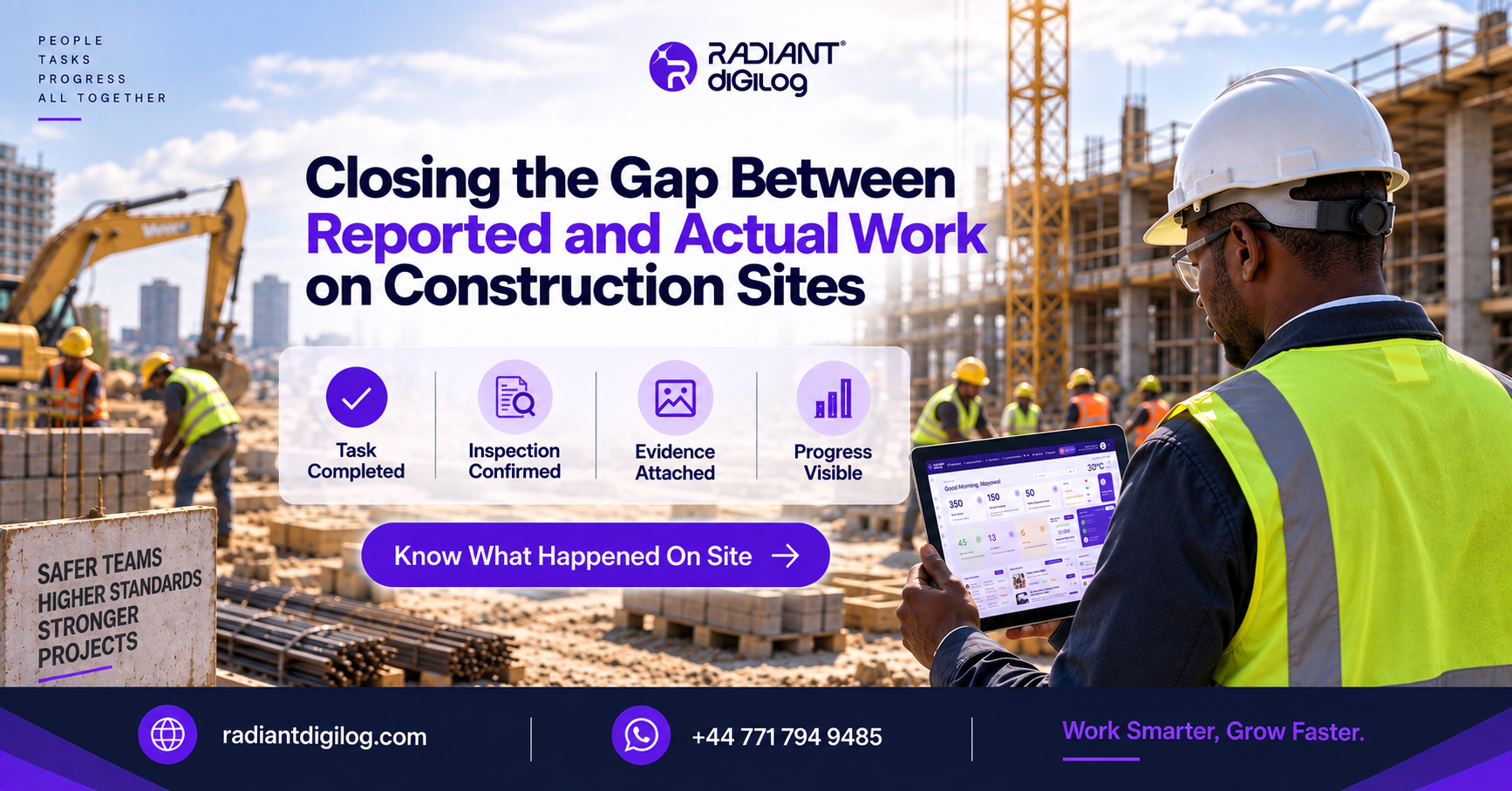
With Radiant diGiLog, construction teams can keep task information, digital forms, evidence and operational updates connected in one environment. Managers get a clearer view of what has been completed, what still needs attention and where follow-up may be required.
That changes the question from “Has this been done?” to something more useful:
“What evidence do we have that it was done?”
For construction managers overseeing multiple crews, sites and deadlines, that distinction can make everyday decisions much easier.
See what is happening across your sites with greater clarity.